Research and Development
Membina generasi pemikir berikutnya melalui bimbingan penelitian yang mendalam, etis, dan inovatif di lingkungan akademik yang mendukung.
Publikasi Jurnal
12 Dokumen
Pembelajaran Daring Berbasis Learning Management System (LMS) Dalam Pengalaman Belajar Mahasiswa Keperawatan: Tinjauan Literatur
The development of digital technology is driving the transformation of learning in nursing education through the use of Learning Management Systems (LMS) as integrated learning media. LMSs play a role in increasing access, learning flexibility, and student engagement. This study used a literature review with the PRISMA approach. Article searches were conducted in the Science Direct, Springer, and BMC databases covering the years 2023-2025. Of the 102 articles found, five met the inclusion criteria and were analyzed thematically. The results indicate that LMSs provide flexible learning access, enhance independence, and support student engagement. Learning satisfaction is influenced by ease of use of the system, content quality, and technological support. Challenges exist such as limited social interaction, technological readiness, and digital literacy. LMSs play a strategic role in enhancing nursing student learning; their success is influenced by technological readiness, institutional support, and innovation in learning.
Upaya Guru Meningkatkan Pengetahuan Sains Melalui Metode Demonstrasi Pada Anak Usia 5-6 Tahun di TK Negeri 01 Tenggarong
Penelitian ini bertujuan untuk mendeskripsikan upaya guru dalam meningkatkan pengetahuan sains anak usia 5–6 tahun melalui metode demonstrasi di TK Negeri 01 Tenggarong. Penelitian menggunakan pendekatan kualitatif dengan jenis penelitian studi kasus. Subjek penelitian terdiri atas kepala sekolah, guru kelas, dan lima anak usia 5–6 tahun. Teknik pengumpulan data dilakukan melalui observasi, wawancara, dan dokumentasi. Analisis data menggunakan model interaktif Miles dan Huberman yang meliputi reduksi data, penyajian data, dan penarikan kesimpulan. Hasil penelitian menunjukkan bahwa penerapan metode demonstrasi dilakukan melalui tiga tahapan, yaitu perencanaan, pelaksanaan, dan evaluasi. Pada tahap perencanaan guru menyusun modul pembelajaran, menentukan tema, serta menyiapkan media dan alat eksperimen. Tahap pelaksanaan dilakukan dengan memperagakan secara langsung berbagai kegiatan sains sederhana, seperti percobaan benda terapung dan tenggelam, pencampuran warna, pengelompokan hewan, serta penyiraman tanaman. Tahap evaluasi dilakukan melalui observasi terhadap keterlibatan dan perkembangan anak selama mengikuti kegiatan pembelajaran. Penerapan metode demonstrasi terbukti mampu meningkatkan rasa ingin tahu, kemampuan mengamati, kemampuan mengelompokkan objek, serta pemahaman konsep sains sederhana pada anak usia 5–6 tahun. Metode demonstrasi juga menciptakan suasana belajar yang aktif, menyenangkan, dan memberikan pengalaman belajar secara langsung sehingga perkembangan pengetahuan sains anak berada pada kategori berkembang sangat baik.
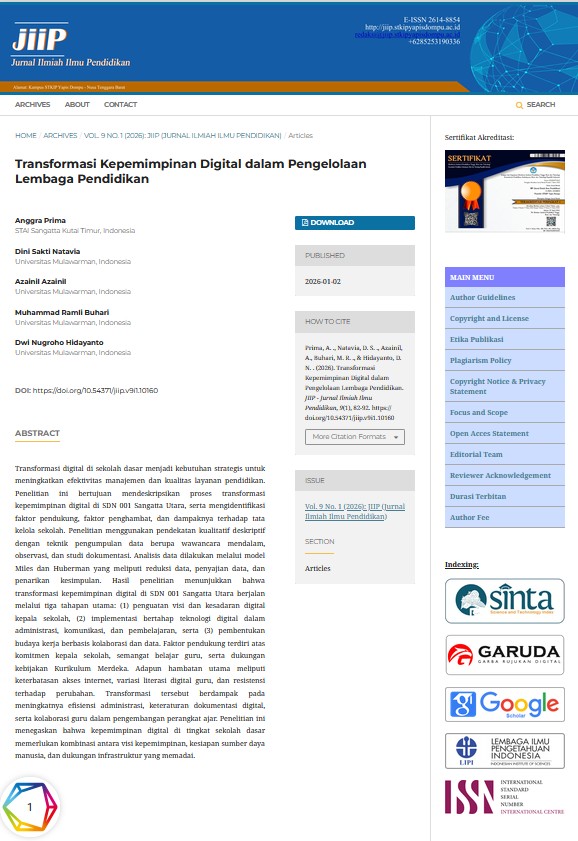
Transformasi Kepemimpinan Digital dalam Pengelolaan Lembaga Pendidikan
Digital transformation in primary schools has become a strategic necessity to improve managerial effectiveness and the overall quality of educational services. This study aims to describe the process of digital leadership transformation at SDN 001 Sangatta Utara, and to identify its supporting factors, inhibiting factors, and impacts on school governance. This research employed a descriptive qualitative approach, with data collected through in-depth interviews, observations, and documentation reviews. Data analysis followed the Miles and Huberman interactive model consisting of data reduction, data display, and conclusion drawing. The findings reveal that digital leadership transformation at SDN 001 Sangatta Utara occurred through three main stages: (1) strengthening the principal’s digital vision and awareness, (2) gradual implementation of digital technologies in administration, communication, and teaching practices, and (3) the establishment of a collaborative and data-driven work culture. Supporting factors included strong leadership commitment, teachers’ learning motivation, and policy reinforcement through the Merdeka Curriculum. Meanwhile, major challenges consisted of limited internet access, varying levels of digital literacy among teachers, and resistance to change. This transformation has led to improved administrative efficiency, more organized digital documentation, and enhanced teacher collaboration in developing instructional materials. The study concludes that effective digital leadership at the primary school level requires a combination of visionary leadership, human resource readiness, and adequate technological infrastructure.
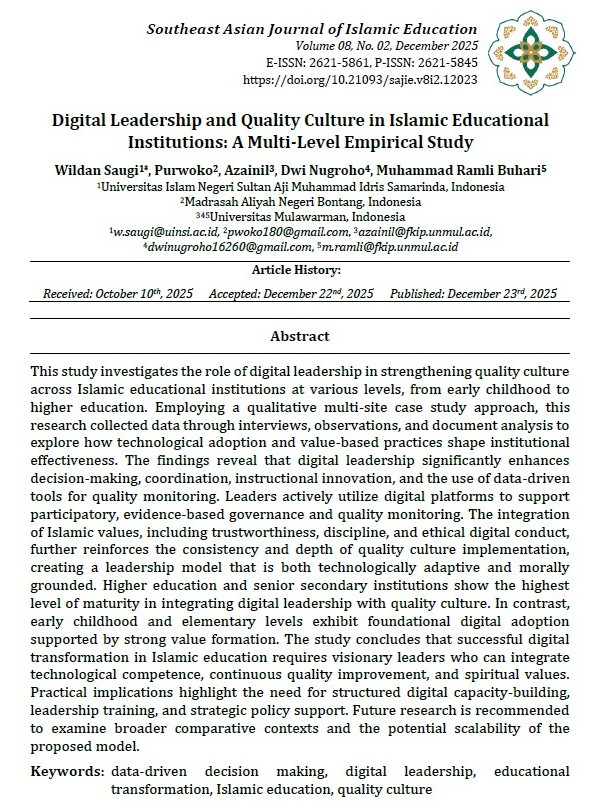
Digital Leadership and Quality Culture in Islamic Educational Institutions: A Multi-Level Empirical Study
This study investigates the role of digital leadership in strengthening quality culture across Islamic educational institutions at various levels, from early childhood to higher education. Employing a qualitative multi-site case study approach, this research collected data through interviews, observations, and document analysis to explore how technological adoption and value-based practices shape institutional effectiveness. The findings reveal that digital leadership significantly enhances decision-making, coordination, instructional innovation, and the use of data-driven tools for quality monitoring. Leaders actively utilize digital platforms to support participatory, evidence-based governance and quality monitoring. The integration of Islamic values, including trustworthiness, discipline, and ethical digital conduct, further reinforces the consistency and depth of quality culture implementation, creating a leadership model that is both technologically adaptive and morally grounded. Higher education and senior secondary institutions show the highest level of maturity in integrating digital leadership with quality culture. In contrast, early childhood and elementary levels exhibit foundational digital adoption supported by strong value formation. The study concludes that successful digital transformation in Islamic education requires visionary leaders who can integrate technological competence, continuous quality improvement, and spiritual values. Practical implications highlight the need for structured digital capacity-building, leadership training, and strategic policy support. Future research is recommended to examine broader comparative contexts and the potential scalability of the proposed model.
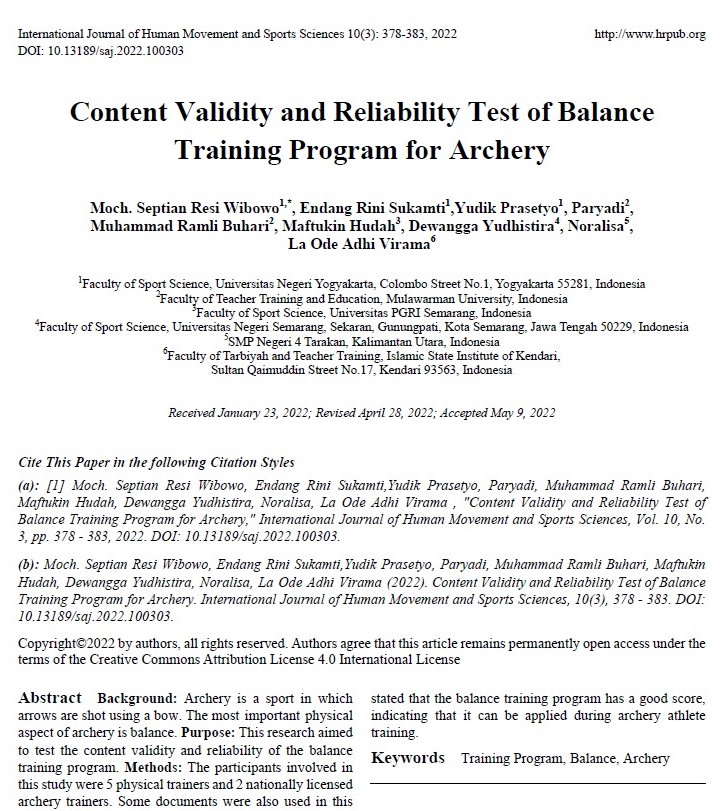
Content Validity and Reliability Test of Balance Training Program for Archery
Archery is a sport in which arrows are shot using a bow. The most important physical aspect of archery is balance. Purpose: This research aimed to test the content validity and reliability of the balance training program. Methods: The participants involved in this study were 5 physical trainers and 2 nationally licensed archery trainers. Some documents were also used in this research. The approach used was a mixed qualitative and quantitative approach. This research was divided into four stages: (1) analyzing e-books, textbooks, and pertinent articles qualitatively, (2) evaluating the program using the Delphi technique, which involves experts assessing questionnaires on a 1 to 5 scale until a consensus is obtained, (3) testing the content validity using the CVR formula, (4) testing the reliability using Cronbach alpha and ICC. Results: The content validity and Cronbach alpha values were found to be 0.754 > 0.6 and 0.71-1.00, respectively, based on the findings. In addition, the ICC single measurement value was 0.1191 with a mean measurement value of 0.486 > 0.75. Conclusion: Based on the content validity and reliability test findings, it can be stated that the balance training program has a good score, indicating that it can be applied during archery athlete training.
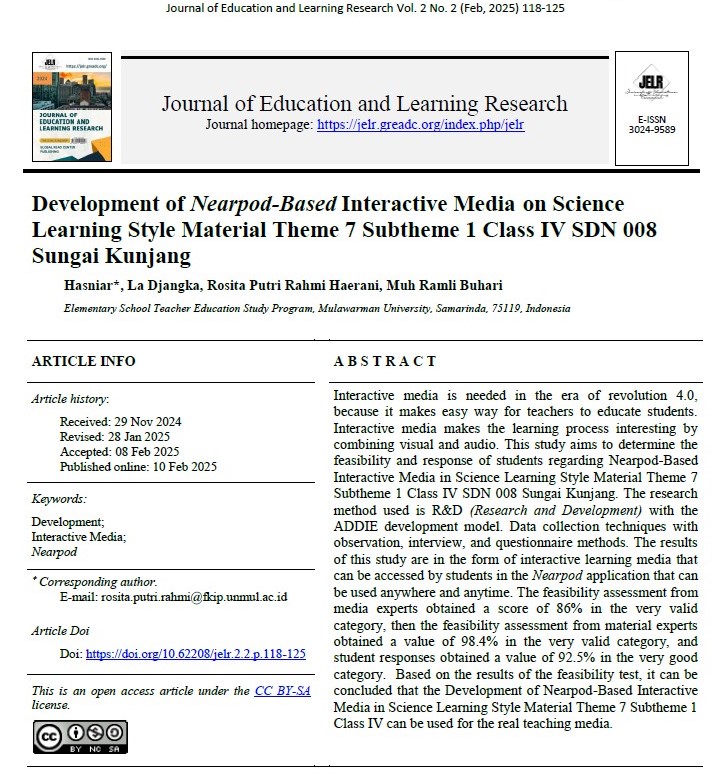
Development of Nearpod-Based Interactive Media on Science Learning Style Material Theme 7 Subtheme 1 Class IV SDN 008 Sungai Kunjang
Interactive media is needed in the era of revolution 4.0, because it makes easy way for teachers to educate students. Interactive media makes the learning process interesting by combining visual and audio. This study aims to determine the feasibility and response of students regarding Nearpod-Based Interactive Media in Science Learning Style Material Theme 7 Subtheme 1 Class IV SDN 008 Sungai Kunjang. The research method used is R&D (Research and Development) with the ADDIE development model. Data collection techniques with observation, interview, and questionnaire methods. The results of this study are in the form of interactive learning media that can be accessed by students in the Nearpod application that can be used anywhere and anytime. The feasibility assessment from media experts obtained a score of 86% in the very valid category, then the feasibility assessment from material experts obtained a value of 98.4% in the very valid category, and student responses obtained a value of 92.5% in the very good category. Based on the results of the feasibility test, it can be concluded that the Development of Nearpod-Based Interactive Media in Science Learning Style Material Theme 7 Subtheme 1 Class IV can be used for the real teaching media.
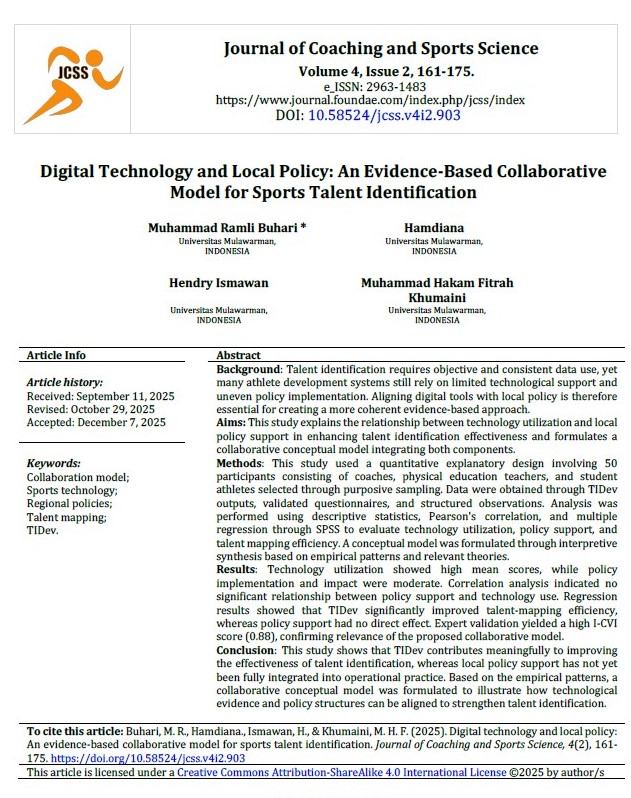
Digital Technology and Local Policy: An Evidence-Based Collaborative Model for Sports Talent Identification
Background: Talent identification requires objective and consistent data use, yet many athlete development systems still rely on limited technological support and uneven policy implementation. Aligning digital tools with local policy is therefore essential for creating a more coherent evidence-based approach. Aims: This study explains the relationship between technology utilization and local policy support in enhancing talent identification effectiveness and formulates a collaborative conceptual model integrating both components. Methods: This study used a quantitative explanatory design involving 50 participants consisting of coaches, physical education teachers, and student athletes selected through purposive sampling. Data were obtained through TIDev outputs, validated questionnaires, and structured observations. Analysis was performed using descriptive statistics, Pearson's correlation, and multiple regression through SPSS to evaluate technology utilization, policy support, and talent mapping efficiency. A conceptual model was formulated through interpretive synthesis based on empirical patterns and relevant theories. Results: Technology utilization showed high mean scores, while policy implementation and impact were moderate. Correlation analysis indicated no significant relationship between policy support and technology use. Regression results showed that TIDev significantly improved talent-mapping efficiency, whereas policy support had no direct effect. Expert validation yielded a high I-CVI score (0.88), confirming relevance of the proposed collaborative model. Conclusion: This study shows that TIDev contributes meaningfully to improving the effectiveness of talent identification, whereas local policy support has not yet been fully integrated into operational practice. Based on the empirical patterns, a collaborative conceptual model was formulated to illustrate how technological evidence and policy structures can be aligned to strengthen talent identification.
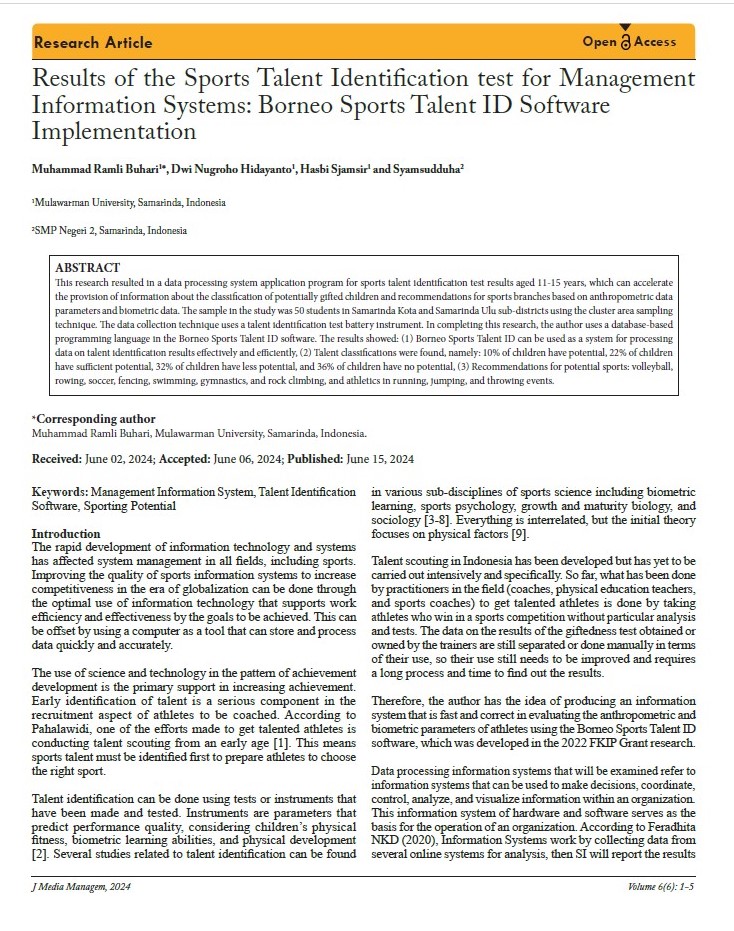
Results of the Sports Talent Identification test for Management Information Systems
This research resulted in a data processing system application program for sports talent identification test results aged 11-15 years, which can accelerate the provision of information about the classification of potentially gifted children and recommendations for sports branches based on anthropometric data parameters and biometric data. The sample in the study was 50 students in Samarinda Kota and Samarinda Ulu sub-districts using the cluster area sampling technique. The data collection technique uses a talent identification test battery instrument. In completing this research, the author uses a database-based programming language in the Borneo Sports Talent ID software. The results showed: (1) Borneo Sports Talent ID can be used as a system for processing data on talent identification results effectively and efficiently, (2) Talent classifications were found, namely: 10% of children have potential, 22% of children have sufficient potential, 32% of children have less potential, and 36% of children have no potential, (3) Recommendations for potential sports: volleyball, rowing, soccer, fencing, swimming, gymnastics, and rock climbing, and athletics in running, jumping, and throwing events.