Jurnal Penelitian
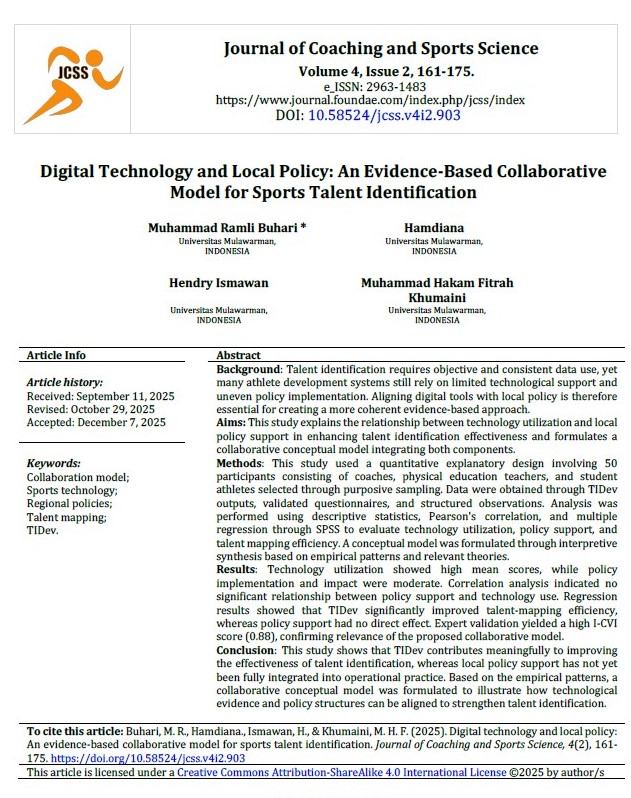
Digital Technology and Local Policy: An Evidence-Based Collaborative Model for Sports Talent Identification
26 July 2026
Dokumen Jurnal/Makalah
Format PDF tersedia untuk diunduh dan dibaca.
Abstrak Penelitian
Background: Talent identification requires objective and consistent data use, yet
many athlete development systems still rely on limited technological support and
uneven policy implementation. Aligning digital tools with local policy is therefore
essential for creating a more coherent evidence-based approach.
Aims: This study explains the relationship between technology utilization and local
policy support in enhancing talent identification effectiveness and formulates a
collaborative conceptual model integrating both components.
Methods: This study used a quantitative explanatory design involving 50
participants consisting of coaches, physical education teachers, and student
athletes selected through purposive sampling. Data were obtained through TIDev
outputs, validated questionnaires, and structured observations. Analysis was
performed using descriptive statistics, Pearson's correlation, and multiple
regression through SPSS to evaluate technology utilization, policy support, and
talent mapping efficiency. A conceptual model was formulated through interpretive
synthesis based on empirical patterns and relevant theories.
Results: Technology utilization showed high mean scores, while policy
implementation and impact were moderate. Correlation analysis indicated no
significant relationship between policy support and technology use. Regression
results showed that TIDev significantly improved talent-mapping efficiency,
whereas policy support had no direct effect. Expert validation yielded a high I-CVI
score (0.88), confirming relevance of the proposed collaborative model.
Conclusion: This study shows that TIDev contributes meaningfully to improving
the effectiveness of talent identification, whereas local policy support has not yet
been fully integrated into operational practice. Based on the empirical patterns, a
collaborative conceptual model was formulated to illustrate how technological
evidence and policy structures can be aligned to strengthen talent identification.